クリエイティブな街づくりを推進する、世界の港町による文化交流プロジェクト BUILDING AND SUSTAINING INTER-CITY RELATIONS THROUGH CULTURAL EXCHANGE AMONG PORT CITIES OF THE WORLD
This Is Not a Map
Yokohama/Zou-no-hana Terrace
March 2026
ART & FIELD RESEARCH IN PROGRESS Artists: James Enos, Forest Kelley
At Zou-no-hana Terrace, an exhibition series titled ZOU-NO-HANA GALLERY SERIES was launched in 2020 with the aim of creating opportunities for people to encounter artists’ expressions in everyday life.
The 14th installment introduces James Enos (Athens, Georgia, USA) and Forest Kelley (Lexington, Kentucky, USA), members of the international exchange initiative, the Port Journey Project.
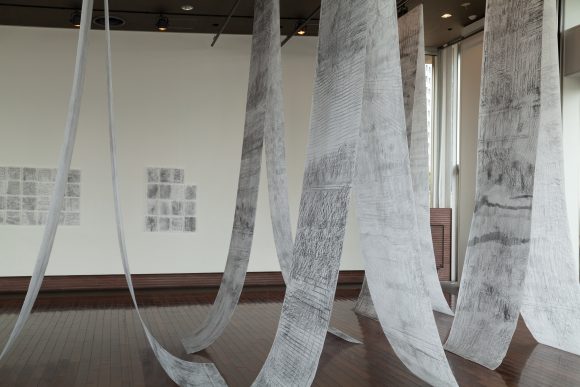
The two artists document port cities and coastal landscapes around the world as they are transformed by climate change, engaging in a practice that seeks to draw new kinds of maps. In this exhibition, set in Yokohama, the results of their field research will be presented as an installation. Enos develops his recordings using the technique of frottage, creating surface rubbings, while Kelley records the sounds that overflow throughout the city.
From March 9 (Mon) to 11 (Wed), the exhibition period included public production sessions, during which the artists visited various locations in the port area, engaged with local communities, and developed their work. These processes will be transformed into a spatial installation and sound pieces, which will be exhibited from March 13 (Fri) to 18 (Wed).
Outline Dates: March 13 (Fri) ‒ 18 (Wed) 2026, 10:00-18:00 *Work in progress: 9 Mon. – 11 Wed. Venue: Zou-no-hana Terrace Organizer: Zou-no-hana Terrace Cooperation: Koganecho Area Management Center
Artists Statement “This Is Not a Map ー Yokohama” examines sea-level rise by tracing the often unseen systems that shape port cities. It treats mapping not as a neutral tool, but as an interpretive practice of translating lived experience, infrastructure, and environmental change into sensory form. Initiated in Amsterdam and Groningen, the project is expanding across North America, Europe, and Asia. Over multiple years, it will culminate in an atlas of alternate mappings to create a living archive of coastal and port geographies reshaped by climate change.
James A. Enos James A. Enos (Athens, Georgia) is an interdisciplinary artist and designer trained in architecture and an Associate Professor at the University of Georgia. His research explores critical practice and systemic change, investigating urbanization, extraction, and the cultural and logistical dimensions of ports. He teaches graduate and undergraduate courses that examine social, environmental, and cultural intersections across art and design.
Forest Kelley Forest Kelley (Lexington, Kentucky) is an artist and experimental composer whose work explores how personal memory and psychology operate within larger social and technological systems. Working across photography, installation, sound, and code, he investigates histories and labor structures that exist beyond public view, tracing how representation reveals and obscures lived experience. His projects often merge documentary impulses with speculative and embodied research, integrating visual art and experimental music into immersive environments. He is an Associate Professor in the School of Art and Visual Studies at the University of Kentucky.
ART & FIELD RESEARCH IN PROGRESS
Artists: James Enos, Forest Kelley
At Zou-no-hana Terrace, an exhibition series titled ZOU-NO-HANA GALLERY SERIES was launched in 2020 with the aim of creating opportunities for people to encounter artists’ expressions in everyday life.
The 14th installment introduces James Enos (Athens, Georgia, USA) and Forest Kelley (Lexington, Kentucky, USA), members of the international exchange initiative, the Port Journey Project.
The two artists document port cities and coastal landscapes around the world as they are transformed by climate change, engaging in a practice that seeks to draw new kinds of maps.
In this exhibition, set in Yokohama, the results of their field research will be presented as an installation.
Enos develops his recordings using the technique of frottage, creating surface rubbings, while Kelley records the sounds that overflow throughout the city.
From March 9 (Mon) to 11 (Wed), the exhibition period included public production sessions, during which the artists visited various locations in the port area, engaged with local communities, and developed their work. These processes will be transformed into a spatial installation and sound pieces, which will be exhibited from March 13 (Fri) to 18 (Wed).
Outline
Dates: March 13 (Fri) ‒ 18 (Wed) 2026, 10:00-18:00
*Work in progress: 9 Mon. – 11 Wed.
Venue: Zou-no-hana Terrace
Organizer: Zou-no-hana Terrace
Cooperation: Koganecho Area Management Center
Artists Statement
“This Is Not a Map ー Yokohama” examines sea-level rise by tracing the often unseen systems that shape port cities. It treats mapping not as a neutral tool, but as an interpretive practice of translating lived experience, infrastructure, and environmental change into sensory form. Initiated in Amsterdam and Groningen, the project is expanding across North America, Europe, and Asia. Over multiple years, it will culminate in an atlas of alternate mappings to create a living archive of coastal and port geographies reshaped by climate change.
James Enos & Forest Kelley
Programs
・March 13 (Fri), 18:00–20:00 Opening event / Artist Talk
・March 14 (Sat), 14:00–15:30 Workshop event
Artists Profile
James A. Enos
James A. Enos (Athens, Georgia) is an interdisciplinary artist and designer trained in architecture and an Associate Professor at the University of Georgia. His research explores critical practice and systemic change, investigating urbanization, extraction, and the cultural and logistical dimensions of ports. He teaches graduate and undergraduate courses that examine social, environmental, and cultural intersections across art and design.
Forest Kelley
Forest Kelley (Lexington, Kentucky) is an artist and experimental composer whose work explores how personal memory and psychology operate within larger social and technological systems. Working across photography, installation, sound, and code, he investigates histories and labor structures that exist beyond public view, tracing how representation reveals and obscures lived experience. His projects often merge documentary impulses with speculative and embodied research, integrating visual art and experimental music into immersive environments. He is an Associate Professor in the School of Art and Visual Studies at the University of Kentucky.
Learn more: forestkelley.net